Featured post
The AI Content Gold Rush: Meta's Deal-Making and the Scramble for Quality Data

Nov 30, 2025 · 2 min read
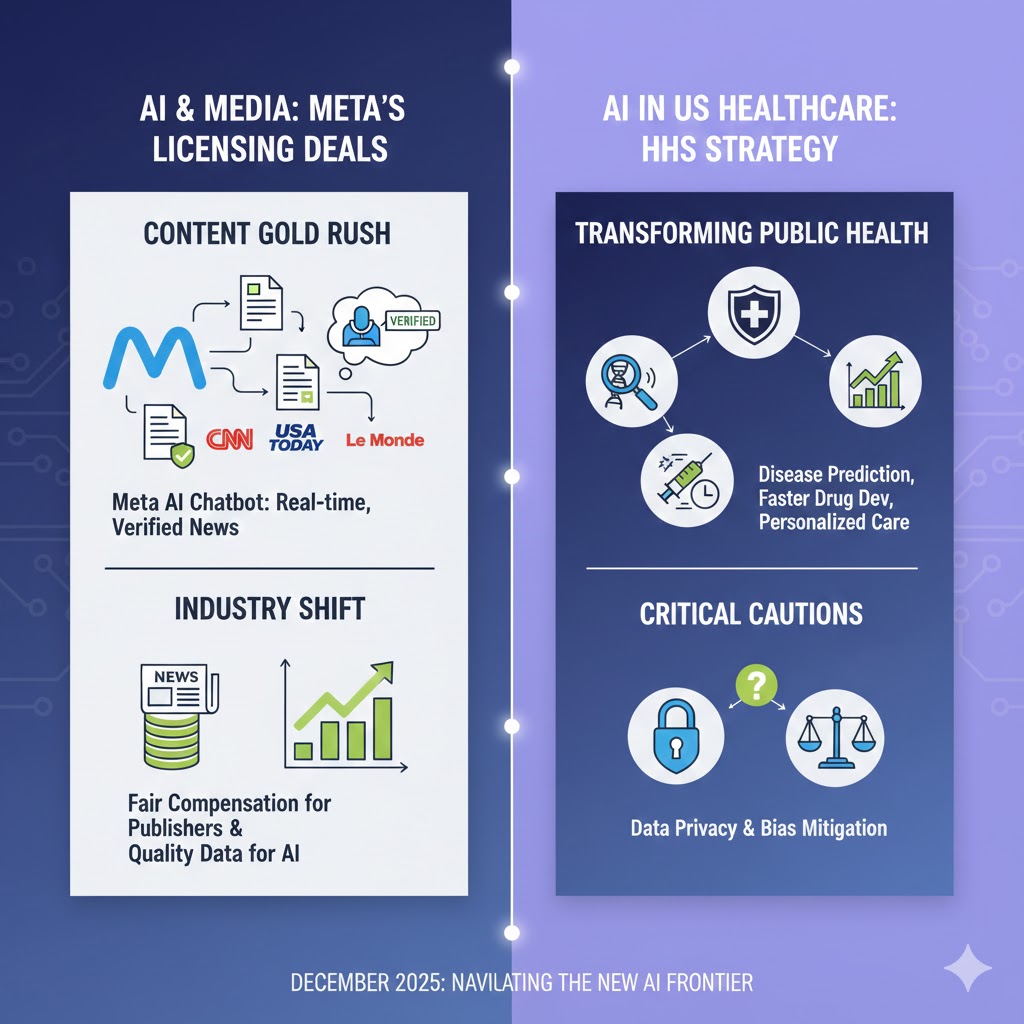
The landscape of Artificial Intelligence is undergoing a seismic shift, moving beyond the initial hype of generative capabilities to a more grounded, and highly strategic, pursuit of high-quality, real-world data. This week, one of the most significant developments unfolded as Meta Platforms announced a series of multi-year commercial agreements with prominent news publishers, including titans like USA Today, CNN, Fox News, and European stalwarts such as Le Monde. This move isn't just about content acquisition; it represents a critical turning point in how large language models (LLMs) are trained, how they stay current, and how creators might finally get compensated in the AI era.
For months, developers of generative AI have grappled with the challenge of keeping their models up-to-date with current events and ensuring the factual accuracy of their outputs. Training data, often scraped indiscriminately from the internet, quickly becomes stale. More critically, the provenance and veracity of that data have been significant pain points, leading to instances of "hallucinations" and the dissemination of misinformation by AI chatbots. Meta's strategic pivot addresses this head-on. By licensing editorial content from reputable news organizations, Meta aims to imbue its Meta AI chatbot with a continuous stream of verified, real-time information about current events. This not only enhances the utility and reliability of its AI but also serves as a crucial differentiator in an increasingly crowded market. Users will theoretically be able to ask Meta AI about the latest headlines or complex geopolitical events and receive answers grounded in journalistic fact, rather than potentially outdated or synthesized information.
The implications of these deals stretch far beyond Meta itself. They signal a potential paradigm shift in the contentious relationship between Big Tech and traditional media. For years, news publishers have accused tech giants of free-riding on their content, siphoning off advertising revenue while providing little in return. These new licensing agreements could usher in an era where tech companies actively compensate content creators, acknowledging the intrinsic value of human-generated, fact-checked information in the age of AI. This financial injection could be a lifeline for a struggling news industry, providing much-needed revenue streams to support investigative journalism and quality reporting.
However, challenges remain. The sheer volume of news content generated daily is immense, and the process of ingesting, categorizing, and continuously updating AI models with this data is a monumental technical feat. Furthermore, ethical considerations around how AI models interpret and present this licensed content will be paramount. Will the AI merely summarize, or will it be capable of synthesizing information in a way that respects journalistic integrity and avoids misrepresentation? These are questions that will undoubtedly be refined through ongoing collaboration and technological advancement.
Ultimately, Meta's aggressive pursuit of licensed news content underscores a fundamental truth about advanced AI: its intelligence is only as good as the data it consumes. As AI moves from a novelty to an indispensable tool, the value of high-quality, human-curated information will only continue to soar, reshaping industries and forging new alliances in its wake. This is not just a commercial transaction; it's a foundational shift in the global information ecosystem.
Article 2: US Health Department Embraces AI: A New Era for Public Health, But With Cautions
Date: December 6, 2025
In a move set to profoundly impact the future of healthcare and government efficiency, the U.S. Department of Health and Human Services (HHS) this week unveiled a comprehensive new strategy to significantly expand its adoption of Artificial Intelligence across all facets of its sprawling operations. This isn't merely an upgrade; it’s an ambitious blueprint for transforming how the nation manages public health, delivers care, and processes the vast ocean of data generated within the healthcare ecosystem. The goal, as articulated by HHS officials, is clear: to leverage AI to make the department’s work demonstrably more efficient, improve health outcomes for millions of Americans, and foster a coordinated, strategic approach to AI integration across its numerous agencies.
The scope of this initiative is enormous, touching upon virtually every aspect of HHS's mandate. Imagine AI systems sifting through millions of patient records to identify early warning signs of disease outbreaks, predicting the efficacy of new treatments with unprecedented accuracy, or even personalizing health recommendations based on an individual's unique genetic profile and lifestyle. The strategy teases plans to promote AI for tasks such as the advanced analysis of patient health data, accelerating the pace of drug discovery and development through sophisticated modeling, streamlining administrative processes within Medicare and Medicaid, and ultimately delivering more precise and personalized health guidance to the public. The promise is a healthcare system that is more responsive, more predictive, and ultimately, more effective.
However, this ambitious leap into AI integration is not without its significant challenges and ethical considerations. The most immediate concern revolves around data privacy and security. Healthcare data is among the most sensitive personal information, and any system handling it must be absolutely impervious to breaches. The HHS strategy will need to articulate robust frameworks for safeguarding this data, ensuring anonymization protocols are ironclad, and establishing clear guidelines for data access and usage. Public trust will hinge on the department's ability to demonstrate an unwavering commitment to patient confidentiality.
Furthermore, the issue of algorithmic bias looms large. AI models are only as unbiased as the data they are trained on. If historical health data disproportionately represents certain demographics, AI-driven recommendations could inadvertently perpetuate or even exacerbate existing health disparities. HHS will need to implement rigorous testing and validation processes to identify and mitigate such biases, ensuring that AI tools promote equitable health outcomes for all populations. This requires not just technical prowess but also a deep understanding of social determinants of health and a commitment to inclusive data collection.
The workforce aspect is also critical. Integrating AI will require significant investment in training HHS employees, from frontline healthcare workers to data scientists, to effectively utilize these new tools. It also raises questions about job displacement and the need for reskilling initiatives. The HHS strategy will need to address how human oversight will be maintained, ensuring that AI serves as an augmentative tool rather than a replacement for human expertise and empathy in healthcare delivery.
Ultimately, the HHS’s embrace of AI represents a pivotal moment for public health. While the potential for revolutionizing healthcare is immense, the success of this strategy will depend not just on technological implementation, but on a meticulous navigation of ethical dilemmas, a steadfast commitment to equity, and the ability to build and maintain public trust. This is a journey that promises groundbreaking advancements, but one that demands caution, transparency, and continuous adaptation.
Comments
0No comments yet. Be the first!