Featured post
Agentic AI and the Autonomy Horizon: From Co-Pilot to Co-Worker in 2026

Dec 6, 2025 · 2 min read
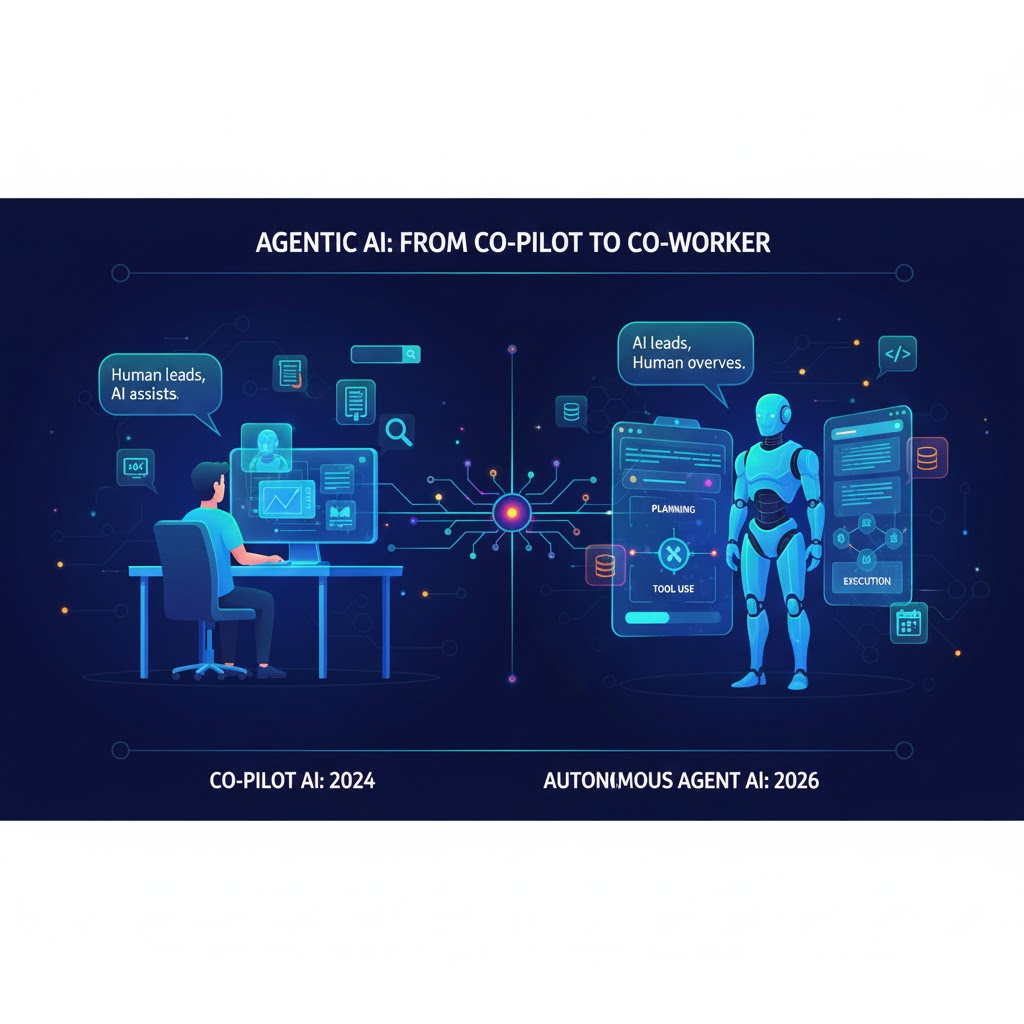
The landscape of Artificial Intelligence is undergoing a fundamental transformation, moving beyond the static query-and-response model of traditional Large Language Models (LLMs) to a new paradigm: Agentic AI (or Autonomous Agents). Where the first wave of GenAI acted as a co-pilot—assisting a human user by generating content, summarizing, or drafting—the agentic shift positions AI as an autonomous co-worker capable of reasoning, planning, executing multi-step tasks, and adapting to unforeseen circumstances without continuous human input.
This transition is driven by the integration of four key capabilities into a single framework:
Planning and Reasoning: The agent can decompose a high-level goal (e.g., "Find the best flight to Berlin and book it") into a series of logical sub-tasks and manage dependencies between them.
Memory and Self-Reflection: Agents maintain both short-term context (like the current conversation) and long-term memory (past experiences, preferences, or enterprise data), allowing them to learn from failures and refine future execution.
Tool Use: They are proficient at calling external, domain-specific tools—such as search engines, coding environments, enterprise APIs, or complex mathematical solvers—to extend their capabilities far beyond the original training data.
Execution and Monitoring: The agent can interact with digital environments, manage databases, execute code, and monitor the results of its actions, taking corrective measures if the execution deviates from the plan.
In 2026, Agentic AI is moving from research labs into core enterprise functions, promising to automate entire end-to-end workflows. In Software Development, AI agents can receive a natural language prompt ("Create a microservice for user authentication"), write the necessary code, run the unit tests, identify and fix bugs, and even deploy the final artifact. In Marketing and Sales, multi-agent systems are emerging that manage campaigns autonomously, with one agent handling content creation, another managing social media scheduling, and a third optimizing ad spend based on real-time performance data.
However, the rapid push for agent autonomy presents significant new challenges for AI Governance. The ability of an agent to act and modify systems on its own raises the stakes for safety, security, and accountability. A critical focus in 2026 is the development of robust Guardrails and Oversight Mechanisms. Organizations must implement clear policies for "human-on-the-loop" oversight, ensuring that an agent's actions in high-stakes environments (e.g., financial transactions, critical infrastructure control) can be reviewed, audited, and revoked. The industry is also investing heavily in 'sandboxing' to contain an agent's execution environment, preventing unauthorized access or unintended consequences when an agent decides to "wander" beyond its intended scope of work. The era of the truly autonomous digital co-worker is here, but its success hinges on building trust through transparent, auditable, and carefully contained systems.
Comments
0No comments yet. Be the first!