Featured post
The AI Revolution: Education and Careers at a Crossroads

Dec 6, 2025 · 2 min read
🎓 Education in the Age of AI and Budget Cuts
The biggest story in education today revolves around the integration of AI and the financial instability of many higher education institutions.
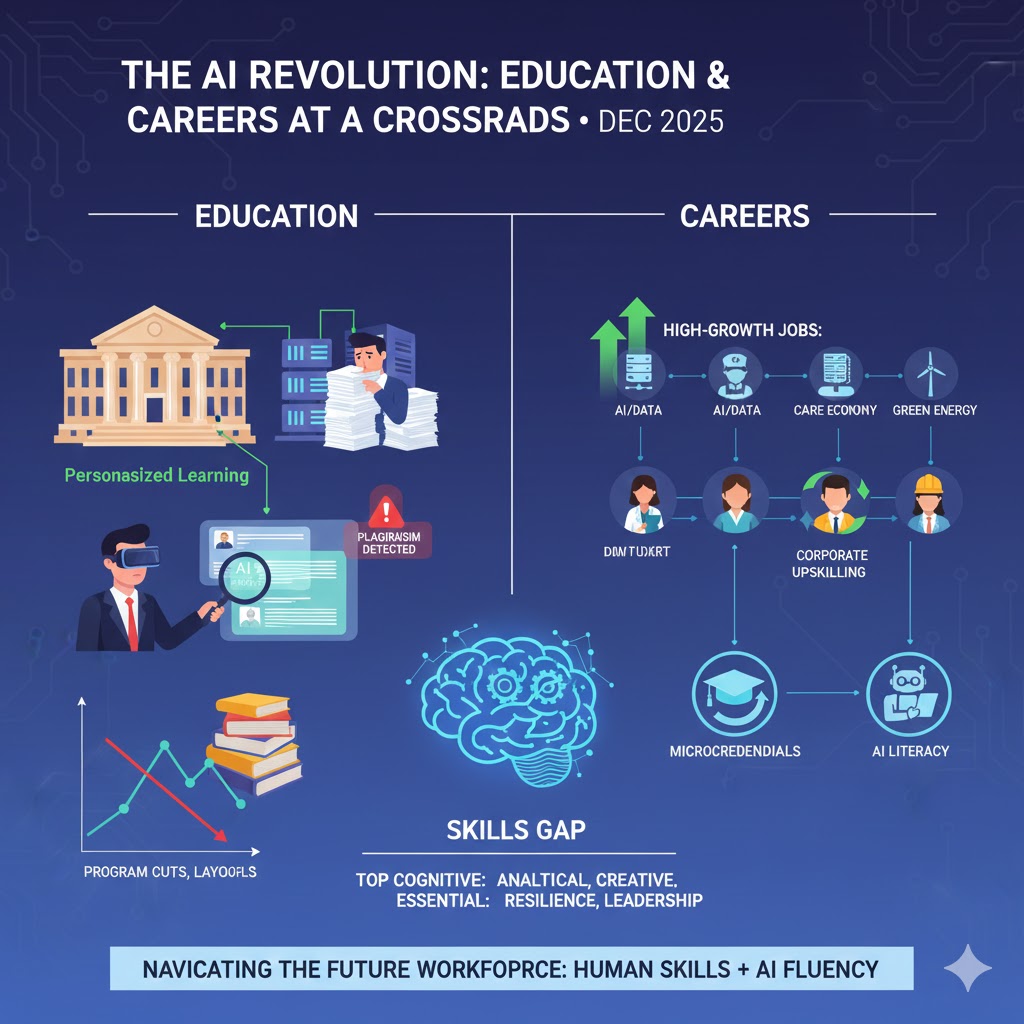
The AI Embrace: Universities are rapidly adopting AI tools, such as the widely reported partnership between large public university systems and platforms like ChatGPT Edu. This is framed as preparing students for an "AI-driven economy" by offering personalized learning systems and using AI for tasks like generating lesson plans and grading. Proponents cite significant increases in student test scores and engagement with adaptive, AI-driven platforms.
The Academic Integrity Crisis: Simultaneously, the use of generative AI has sparked intense debate over academic integrity. High rates of plagiarism are being reported, forcing educators to dedicate more time to verifying the authenticity of student work. There's a fundamental concern among academics that the unchecked adoption of AI in classrooms could erode critical thinking, reasoning, and fundamental cognitive abilities, creating graduates who rely too heavily on automation.
The Financial Squeeze: This technological shift is occurring against a backdrop of significant budget deficits, leading to the elimination of academic programs (especially in humanities and social sciences) and faculty layoffs at various institutions. Universities are juggling the cost of large-scale AI initiatives with severe financial constraints, leading to a focus on efficiency and vocational training over broader critical inquiry.
💼 The Evolving Career Field: Skills and Demand
The job market is reflecting these shifts, prioritizing a new mix of technical and human-centric skills while grappling with a pervasive skills gap.
High-Growth Career Areas
The fastest-growing jobs are centered around technology and the care economy:
Technology Roles: Big Data Specialists, Fintech Engineers, AI and Machine Learning Specialists, and Software Developers are seeing explosive growth.
Care Economy Roles: Driven by demographic changes, jobs like Nursing Professionals, Social Work and Counselling Professionals, and Tertiary and Secondary Education Teachers are also projected to grow significantly.
Green/Energy Transition Roles: Specialists in Autonomous and Electric Vehicles and Renewable Energy are in high demand as industries pivot toward sustainability.
The Critical Skills Gap
Employers are facing a widespread skills gap, with nearly two-thirds of businesses identifying it as the biggest barrier to transformation. The required skills are evolving quickly:
Top Cognitive Skills: Analytical Thinking and Creative Thinking remain the most sought-after core skills.
Essential Human Skills: Resilience, Flexibility, Agility, Leadership, and Social Influence are considered increasingly vital, especially as AI takes over routine tasks.
Technical Fluency: AI and Big Data, Networks and Cybersecurity, and Technology Literacy are among the fastest-growing specific skills required across all sectors.
🔑 The Focus on Upskilling and Microcredentials
In response to the rapid obsolescence of traditional skill sets, continuous learning is no longer optional—it's a necessity for workforce resilience.
Corporate Reskilling: Large firms are making significant investments in employee reskilling and upskilling programs to fill talent gaps and improve retention. Training is shifting away from simple course completion toward measurable behavioral changes and direct business results.
AI Literacy Programs: To bridge the proficiency gap, organizations are launching concise training programs, such as CompTIA's AI Essentials, aimed at giving non-technical employees the fluency to use tools like ChatGPT and Copilot productively and securely.
Microcredentials: There is a notable expansion of microcredentials and digital badges as flexible alternatives to traditional degrees. These certifications are gaining traction as a way to quickly validate specific skills and knowledge that directly align with current market demands.
Comments
0No comments yet. Be the first!