Featured post
🏦 The Financial Frontier: AI, Interest Rates, and the Shift to Strategic Finance

Dec 6, 2025 · 2 min read
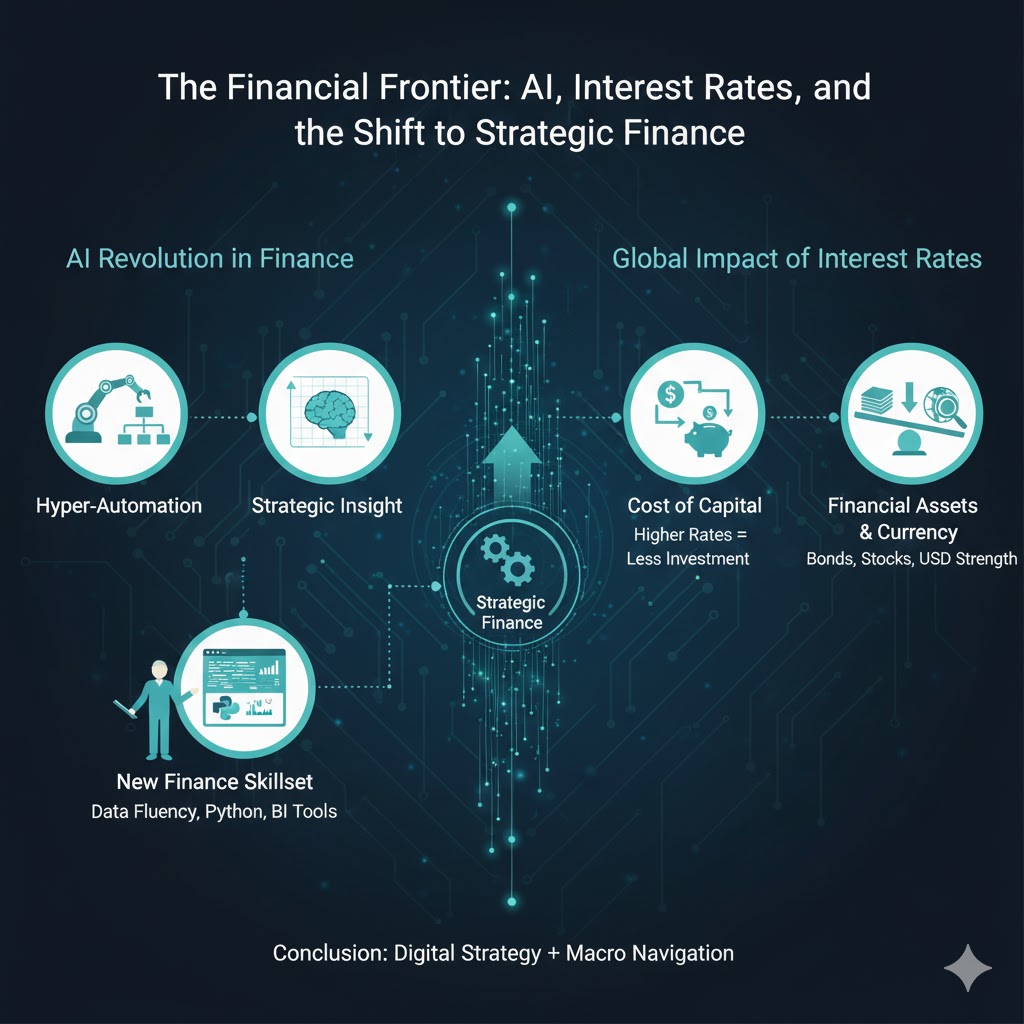
The landscape of business and finance is currently defined by two powerful, interconnected forces: the transformative power of digital technology (especially AI) and the pervasive impact of monetary policy (interest rates). Organizations today must navigate both a digital transformation internally and a challenging macroeconomic environment externally to secure growth and maintain stability.
1. The AI Revolution in Finance 🤖
Artificial Intelligence is fundamentally rewriting the functions of the corporate finance department, moving it from a backward-looking "scorekeeper" role to a strategic, forward-looking "business partner."
Hyper-Automation and Efficiency: Technologies like Robotic Process Automation (RPA) and Machine Learning are automating routine, transactional tasks—such as invoice matching, account reconciliations, and data entry. This "touchless" processing frees finance professionals from manual work, drastically reducing errors and speeding up financial cycles.
Strategic Insight and Forecasting: The most significant shift is in Financial Planning and Analysis (FP&A). AI models can process massive, complex datasets to provide real-time, predictive analytics for better decision-making. Finance teams can now offer more accurate cash flow forecasting, profitability analysis, and scenario planning, allowing management to make capital allocation decisions with greater confidence.
Decentralized Finance (DeFi) & Digital Assets: While still emerging, the underlying technologies of DeFi, stablecoins, and digital assets are influencing traditional finance. They push for greater transparency, efficiency in cross-border payments, and the use of smart contracts for automated agreement execution, compelling traditional institutions to modernize their core systems.
The New Finance Skillset: The demand for finance professionals is shifting from accounting expertise to data fluency—skills in tools like Python, R, Tableau, and Power BI are becoming essential to manage, clean, and interpret the data generated by new digital systems.
2. The Global Impact of Interest Rates 📉
Interest rates, primarily set by central banks like the Federal Reserve, remain the single most influential factor shaping the global business and financial environment. They act as a macroeconomic throttle to control inflation and manage economic growth.
Cost of Capital for Businesses:
Higher Rates: Increase the cost of borrowing for businesses, which can deter them from making large capital expenditures, hiring, or expanding. Higher interest payments also reduce corporate profit margins, which can lead to lower stock valuations as future earnings are discounted more heavily.
Lower Rates: Encourage borrowing and investment, stimulating economic growth and job creation.
Impact on Financial Assets:
Bonds: Interest rates have an inverse relationship with existing bond prices: when rates rise, the value of existing, lower-yield bonds falls. Conversely, when rates fall, older bonds become more valuable.
Stocks: The overall stock market tends to react negatively to sharp rate hikes, as higher costs and dampened consumer spending can reduce corporate profits.
Global Currency Flows: U.S. interest rate changes have a cascading effect internationally. When U.S. rates rise, capital often flows toward dollar-denominated assets seeking higher returns, strengthening the dollar. This puts pressure on emerging market currencies and can force their central banks to raise rates domestically to maintain currency stability, creating a complex balancing act for global trade and investment.
Conclusion: Strategy is Key
The future of business and finance requires a dual focus: internally, on digital transformation to leverage AI for superior efficiency and strategic insight; and externally, on agile macroeconomic navigation to manage the volatility driven by interest rate cycles and global capital flows. Companies that successfully merge their digital strategy with a keen understanding of global financial forces will be best positioned for sustained profitability and resilience.
Comments
0No comments yet. Be the first!