Featured post
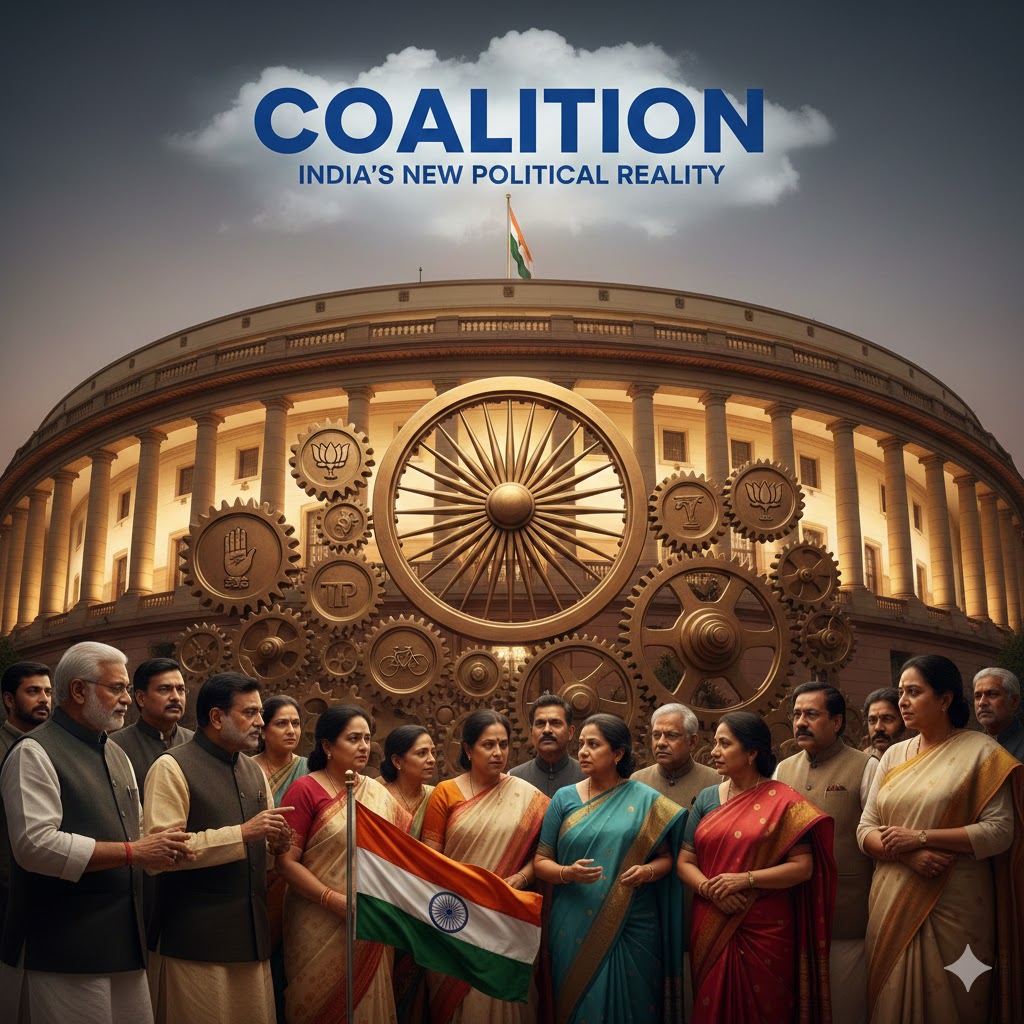
🇮🇳 The Coalition Conundrum: Navigating India's New Political Reality

Dec 6, 2025 · 2 min read
India, the world's most populous democracy, has entered a fascinating and complex phase following the 2024 General Elections. While Prime Minister Narendra Modi secured an unprecedented third term, his Bharatiya Janata Party (BJP) lost its absolute majority in the Lok Sabha. This significant shift has fundamentally altered the political landscape, moving the country from a dominant single-party rule to a coalition government led by the National Democratic Alliance (NDA). This new reality presents both opportunities for renewed legislative consultation and considerable challenges to policy-making speed and stability.
The New Balance of Power
The election results underscored a strong mandate for continuity in leadership but also delivered a clear message to the ruling establishment. The BJP was forced to rely on crucial regional allies—chiefly the Telugu Desam Party (TDP) of Andhra Pradesh and the Janata Dal (United) (JDU) of Bihar—to cross the majority mark. This dependence on partners has re-energised the concept of federalism and coalition dharma, where the demands and interests of state-level parties now wield decisive national influence.
The opposition, galvanized under the INDIA alliance, staged a stronger-than-expected comeback, dramatically increasing its tally. This consolidated opposition is likely to be far more assertive in Parliament, ensuring greater scrutiny of government actions and making the passage of contentious legislation a challenging endeavor. The political discourse is expected to become more robust, moving away from the past decade's unilateral decision-making.
Economic and Policy Challenges Ahead
The return to coalition politics will inevitably impact the speed of economic reforms. Historically, coalitions have tended towards a more consensus-based, and sometimes slower, policy approach. Key partners like the TDP and JDU have their own regional agendas, often revolving around special development packages, infrastructure investments, and caste-based demands. Balancing these regional necessities with the central government's national agenda, such as pursuing the goal of becoming a developed nation by 2047, will be a tightrope walk.
The government's focus is expected to lean heavily on populist measures to address concerns that resonated during the election: high youth unemployment and persistent inflation. Increased welfare spending and measures to stimulate consumption, possibly in the form of enhanced subsidies or new social sector schemes, are anticipated in the upcoming budget. Structural reforms in areas like land, labour, or deep-seated bureaucratic changes might be put on the back burner to maintain coalition harmony.
Diplomacy and Geopolitics
Despite domestic shifts, India’s foreign policy, centred on multi-alignment and boosting its global stature, is set to continue. Recent diplomatic engagements, such as deepening ties with key partners like Russia and the United States, underscore this trajectory. However, the internal political constraints might subtly affect India's international positioning. For instance, any future moves on sensitive internal matters, like the implementation of the Citizenship (Amendment) Act (CAA) or a potential Uniform Civil Code, will require greater caution to avoid upsetting coalition partners and sparking large-scale domestic dissent, which could, in turn, draw international attention.
The new political chapter signifies a crucial test for Indian democracy, challenging the government to move from an era of majoritarian strength to one of collaborative governance. The ability of the NDA to manage internal dissent and forge a workable consensus will determine the stability and efficacy of India’s national politics over the next five years.
Comments
0No comments yet. Be the first!