Featured post
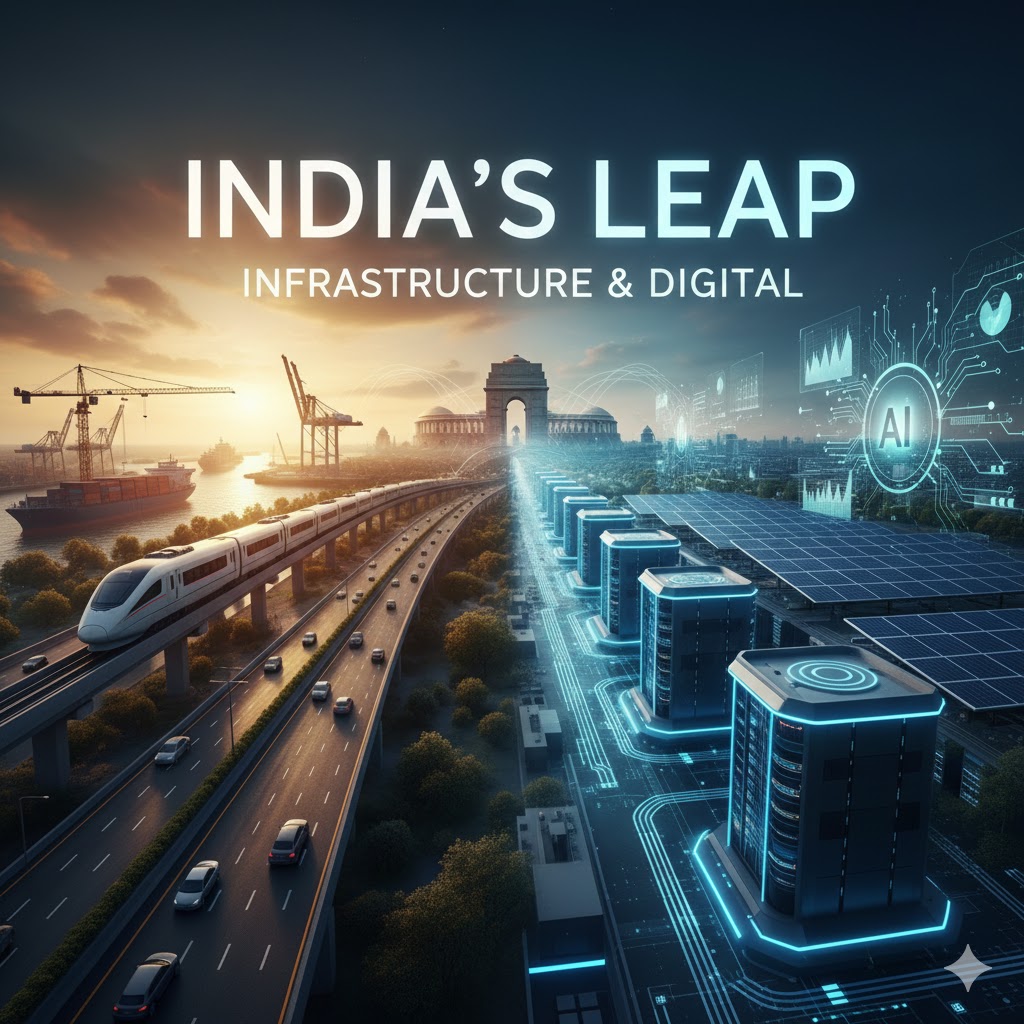
🏗️ Building a $5 Trillion Economy: India’s Infrastructure and Digital Leap

Dec 6, 2025 · 2 min read
India's ambition to become a developed nation by 2047 is being underpinned by a massive, multi-sectoral focus on infrastructure, creating one of the largest development programmes globally in the 21st century. This push, spanning physical connectivity and cutting-edge digital technology, is not just about building roads and ports; it's about fundamentally re-engineering the backbone of the Indian economy to sustain high growth and absorb its vast, young workforce.
The Infrastructure Surge: Physical and Financial
The government's heavy expenditure on capital projects—highways, railways, metro systems, and ports—continues to be a primary driver of economic growth, offsetting slower private consumption in certain areas. Recent developments underscore this momentum:
Sustainable Urban Mobility: The European Investment Bank (EIB) has announced a significant investment of nearly €290 million to extend the Nagpur and Pune metro rail systems, highlighting a long-term shift towards cleaner, inclusive urban transport. India is now the largest beneficiary of EIB transport investments outside of Europe.
Safety and Modernization: Indian Railways is expanding its indigenous train collision avoidance system, Kavach 4.0, across crucial corridors like Delhi–Mumbai and Delhi–Howrah, enhancing safety on the country's busiest routes.
However, this rapid expansion also brings challenges. A Supreme Court judge recently stressed the urgent need for stronger arbitral institutions and dedicated construction law to resolve the inevitable disputes that threaten to stall large projects, ensuring that legal bottlenecks do not impede the national development timeline.
The Digital Foundation: AI and Green Energy
The infrastructure drive is increasingly converging with the digital economy, attracting massive foreign and domestic investment in next-generation technology:
AI Data Hubs: In a landmark move, the Adani Group pledged up to $5 billion to support Google's new AI data centre campus in Visakhapatnam, Andhra Pradesh. This project, which aims for 1 gigawatt of power capacity, signifies India's pivot towards becoming a global hub for digital infrastructure and energy-heavy AI computing.
Rooftop Solar Revolution: The Asian Development Bank (ADB) approved a $650 million loan to accelerate the adoption of rooftop solar systems for 10 million households under the Pradhan Mantri Surya Ghar: Muft Bijli Yojana. This program is vital for addressing climate goals, easing pressure on the power grid, and creating green jobs.
These investments are crucial, as analysts project India’s data centre capacity could nearly quadruple by 2030, a growth rate that demands sustainable energy sources and advanced infrastructure to meet the exploding demand from cloud computing and AI.
The Economic Horizon
Despite this bullish outlook on investment, structural challenges persist. Economists caution that stagnant savings and investments could cap medium-term growth at around 6-7%, falling short of the 8%+ required to achieve developed nation status by 2047. Furthermore, the rupee's persistent weakness against the dollar, recently breaching the ₹90 mark, threatens to fuel imported inflation, especially for critical commodities like crude oil and industrial metals, potentially complicating the government's efforts to balance growth with price stability.
India’s current momentum is undeniable, but sustaining it will require not only the continued flow of capital into physical and digital infrastructure but also deep, long-pending reforms in areas like land, labour, and financial markets to fully unlock the nation's economic promise.
Comments
0No comments yet. Be the first!