Featured post
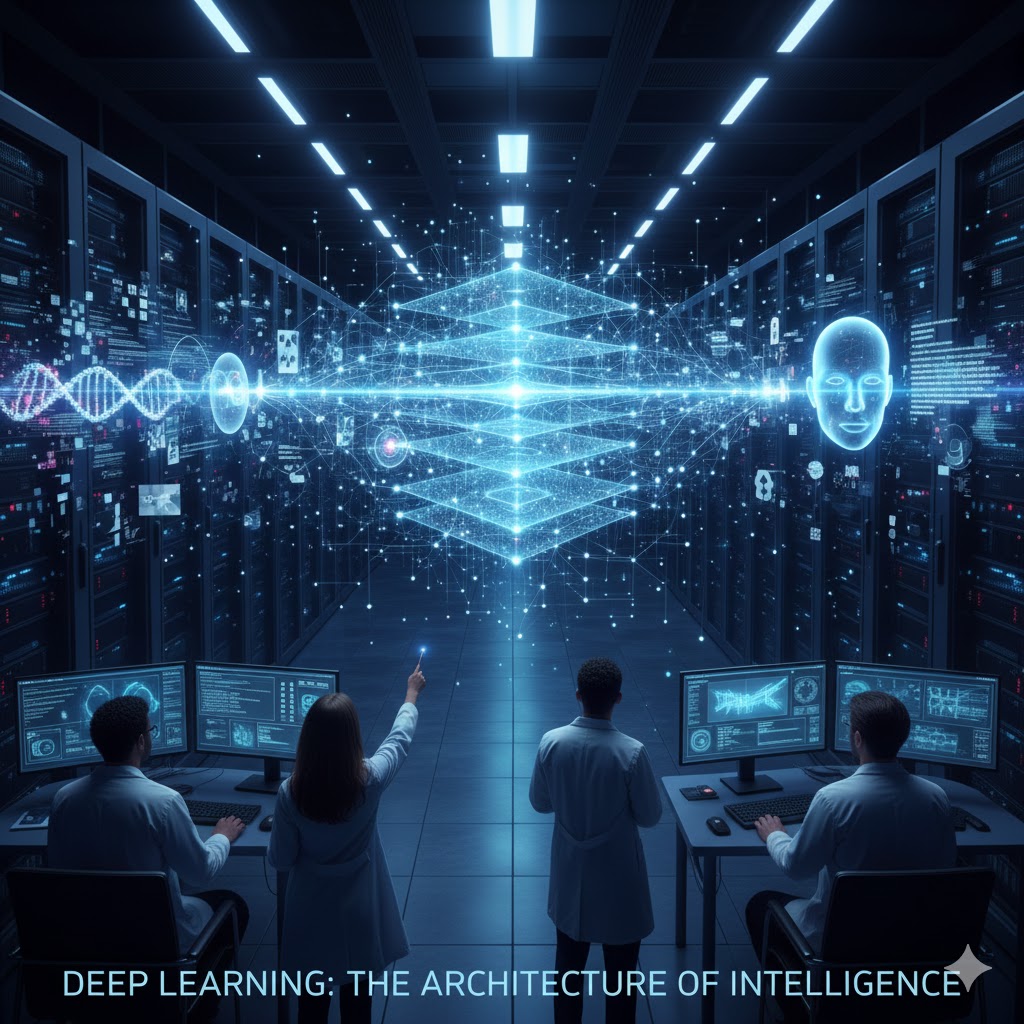
Deep Learning: The Engine Behind Modern AI's Breakthroughs

Dec 6, 2025 · 2 min read
Deep Learning is a powerful subfield of machine learning that has revolutionized Artificial Intelligence (AI) in recent years. Inspired by the structure and function of the human brain, deep learning algorithms enable computers to learn from vast amounts of data, identifying complex patterns and making intelligent decisions or predictions without explicit programming. It's the technology behind breakthroughs like facial recognition, self-driving cars, sophisticated language translation, and the generative AI models we see today.
What Makes Deep Learning "Deep"?
The "deep" in deep learning refers to the use of artificial neural networks with multiple layers of interconnected "neurons."
Artificial Neural Networks (ANNs): These are computational models inspired by biological neural networks. They consist of an input layer, one or more hidden layers, and an output layer.
Layers and Feature Extraction: Each layer of the network transforms the input data to extract increasingly abstract and complex features.
For example, in image recognition, an early layer might detect edges, a middle layer might recognize shapes (like eyes or noses), and a deeper layer might identify entire objects or faces.
Learning Through Data: Deep learning models are trained by feeding them enormous datasets. Through a process called backpropagation, the network adjusts the "weights" (the strength of connections between neurons) and "biases" to minimize the error between its predictions and the actual outcomes.
Key Types of Deep Learning Architectures
Different deep learning architectures are designed for specific types of data and tasks:
Convolutional Neural Networks (CNNs):
Best for: Image and video processing, computer vision tasks.
How they work: CNNs use "convolutional layers" that act like filters, scanning images to detect specific features (e.g., edges, textures, patterns). They are particularly effective because they can automatically learn spatial hierarchies of features from raw pixel data.
Applications: Facial recognition, object detection (e.g., in self-driving cars), medical image analysis.
Recurrent Neural Networks (RNNs):
Best for: Sequential data, where the order of information matters (e.g., text, speech, time series).
How they work: RNNs have "memory" because they pass information from one step in the sequence to the next. This allows them to understand context within a sequence.
Challenges: Basic RNNs struggle with long-term dependencies (remembering information from early in a long sequence).
Applications: Speech recognition, machine translation, natural language processing (NLP).
Long Short-Term Memory (LSTM) Networks and Gated Recurrent Units (GRUs):
Best for: Addressing the long-term dependency problem in RNNs.
How they work: LSTMs and GRUs are specialized types of RNNs that incorporate "gates" to regulate the flow of information, allowing them to selectively remember or forget inputs over extended sequences.
Applications: Highly effective in language modeling, generating complex text, and more accurate speech recognition.
Transformer Models:
Best for: Highly parallelized processing of sequential data, excellent for very long sequences and complex relationships.
How they work: Introduced in 2017, Transformers rely on an "attention mechanism" that allows them to weigh the importance of different parts of the input sequence when making predictions. This allows them to process entire sequences in parallel, unlike RNNs which process sequentially.
Applications: The backbone of most modern Large Language Models (LLMs) like GPT (Generative Pre-trained Transformer), BERT, and T5, driving advances in text generation, summarization, and complex reasoning.
Why Deep Learning is So Powerful Now
The recent explosion in deep learning capabilities is due to several converging factors:
Big Data: The availability of massive datasets for training.
Computational Power: Advances in Graphics Processing Units (GPUs) and specialized AI hardware provide the parallel processing power needed to train deep networks efficiently.
Algorithmic Innovations: Improvements in network architectures, activation functions, and optimization techniques.
Comments
0No comments yet. Be the first!